There are lots of entry points to crypto. Of course, I would say start by subscribing to the DendaraHoldings.com blog and reading everything posted on the site, but that is my biased opinion. As far as steps go, however, I would suggest learning something about the various types of tokens—also called coins, digital assets, crypto, or cryptocurrencies—and planning to start with two or three. Any amount of crypto you purchase is known as your bag.
There are several main categories of cryptocurrencies, and each one has a specific purpose in the digital economy. Store-of-value tokens try to act like digital gold by protecting wealth over time. Meme coins are mostly created for fun or community hype, and their value comes from popularity rather than real-world use. Utility tokens are designed to help a blockchain perform a job, like paying for transactions or powering applications. There are privacy tokens, which are designed to be untraceable. There are NFTs, which represent real-world items (usually artwork) that have been tokenized. Beyond these, there are also stablecoins, which are designed to keep a steady price, and governance tokens, which allow people to vote on how a blockchain project should evolve.
When we hear stories about people becoming crypto millionaires, it’s usually because they bought a token very early—before it became popular or widely known. The first major cryptocurrency, Bitcoin (BTC), appeared for the public around 2011–2012, and in its earliest trading days it sold for well under a dollar, with prices as low as thirty cents. Most regular people heard rumors about it but didn’t take it seriously; I certainly didn’t. The people who did buy early were mostly techs in the field who had been following the technology as it evolved and understood its potential. If someone had bought one hundred dollars’ worth of Bitcoin at thirty cents each, they would now have about 333 BTC—worth over thirty million dollars today—assuming they never lost their private keys, sent their coins to the wrong address, got scammed, were hacked, or kept their coins on an exchange that later failed. Ethereum (ETH) was the next big token to rise in a similar way. Anyone who bought even a modest amount when ETH was under a dollar would now be sitting on a life-changing investment.
A common saying is that wealthy people grow their money instead of letting it sit still. In the crypto space, experienced investors—often called HODLers—look for ways to make their tokens earn more tokens. They might stake their crypto to earn yield, or they might sell part of their holdings during a bull market and reinvest in projects that haven’t taken off yet. Bitcoin and Ethereum are examples of store-of-value coins, meaning they are treated like digital assets that hold long-term worth. They operate on their own blockchains and are considered first-tier tokens. However, despite their popularity, both have drawbacks: Bitcoin transactions are slow, and Ethereum can be very expensive to use because of gas fees. For these reasons, hundreds of second-tier tokens have been built on top of these blockchains, offering improvements in speed, cost, and functionality.

There are thousands of meme coins in the crypto space. These tokens are usually created as jokes or based on characters and ideas people feel emotionally connected to. Some traders even call them “shitcoins,” because many beginners learn the hard way that most of them have no real value and can disappear without warning. Even so, they can be fun to collect, almost like digital trading cards or badges from back in the day. Some well-known meme coins include PEPE (the cartoon frog), Peanut the Squirrel, Pudgy Penguins, Shiba Inu, and DOGE, which became famous partly because of Elon Musk’s tweets. One problem with meme coins is how quickly knock-offs appear. As soon as a meme coin becomes popular, shady developers race to create copycat versions with almost the same name or mascot. This often confuses new investors, who think they’re buying the real coin but end up holding a worthless imitation. Most meme coins fade away, and only a very small number of early buyers ever make a significant profit. Still, the rare success stories do exist. If you had bought DOGE when it cost just $0.00015 and sold it when it reached $0.35, you’d probably be smiling pretty hard today.

Utility tokens are digital assets that have a job to do. They come in many categories, and each one plays a different role in the digital space. Payment and settlement tokens, especially the ISO 20022 group like XRP, XLM, XDC, QUANT, and HBAR, help banks and entire countries move money quickly and safely as part of the new financial system. Smart-contract platform tokens such as ETH, ADA, SOL, AVAX, and DOT act like programmable blockchains where developers build apps, games, and digital services. Interoperability or bridge tokens—including ATOM, LINK, DOT, and even XRP—connect different blockchains so they can share data and value. AI and smart-city tokens like FET, AGIX, OCEAN, IOTA, and HNT support machine-to-machine communication, digital ID systems, energy grids, and artificial intelligence networks. Metaverse tokens, such as MANA (Decentraland), SAND (The Sandbox), and APE(Bored Ape ecosystem), power virtual worlds, digital land, and avatar economies. Gaming and play-to-earn tokens like AXS, GALA, and ILV allow players to earn or spend crypto inside game worlds. Governance tokens, including UNI, MKR, and AAVE, let holders vote on how a project should grow or change. Finally, infrastructure tokens like FIL, AR, CKB, and THETA support decentralized storage, bandwidth, and computing power. Together, these categories show how wide, flexible, and fast-growing the crypto ecosystem has become.

Privacy coins form another crucial category of cryptocurrency, and they are designed to keep financial information hidden even on public blockchains. Tokens like Zcash (ZEC) and Monero (XMR) use advanced cryptography so that transaction details—such as wallet addresses, amounts, and balances—cannot be traced unless the owner chooses to reveal them. Although these tokens are often described as tools for everyday people, in reality it will likely be governments, corporations, and the extremely wealthy who make the most use of them. These groups already understand the importance of financial secrecy and will need ways to move large amounts of money without exposing their strategies, holdings, or political relationships. As the world shifts toward fully trackable digital payments and CBDCs, privacy coins become even more valuable because they offer a rare form of digital confidentiality. This is one reason ZEC suddenly spiked during the November market crash—investors recognized that privacy is a luxury asset in a surveillance-heavy financial landscape, and Zcash’s recent technology upgrades made it especially attractive to institutions and high-net-worth players looking for private ways to store or move value.
NFTs, or non-fungible tokens, are unique digital assets that prove ownership of something on the blockchain. Unlike regular tokens such as Bitcoin or XRP, which are all identical, each NFT has its own identity, making it perfect for digital art, music, collectibles, in-game items, and membership passes. The real value of NFTs is not the pictures people see online but the verification behind them. Because the blockchain acts as proof of ownership, NFTs can be used far beyond art. Brands use them for digital memberships, musicians use them to sell exclusive access to fans, and game developers use them to give players true ownership of their characters and items instead of holding everything on company servers.

NFTs live on blockchains like Ethereum, Solana, and Polygon, and their key purpose is to prove who owns a specific digital item. That item might be artwork, music, a collectible, a character in a game, digital land, or even a ticket to a real-world event. The token itself is the receipt. As investments, NFTs are unpredictable. Some collections like Bored Ape Yacht Club, CryptoPunks, or Azuki sold for massive amounts at their peak, while most NFTs dropped heavily once the hype cycle ended. Their long-term value depends on whether they provide real utility—such as access, identity, rights, or membership—or whether they are simply speculative collectibles. In the future, NFTs may support digital IDs, academic certificates, property records, medical files, and even government documents—anything requiring secure ownership without a middleman.
Stablecoins are the digital dollars of the crypto space. Their main purpose is to hold a steady value—usually one U.S. dollar per coin—so people can move money in and out of other cryptocurrencies without worrying about price swings. Because they stay stable, they act like the cash layer of crypto, making them the easiest way for investors to onboard into the ecosystem and the easiest way to exit back into dollars. In cashless societies and digital economies, stablecoins become the everyday spending money: how employers pay salaries, how people buy goods and services, and how businesses move funds between banks, platforms, and exchanges.
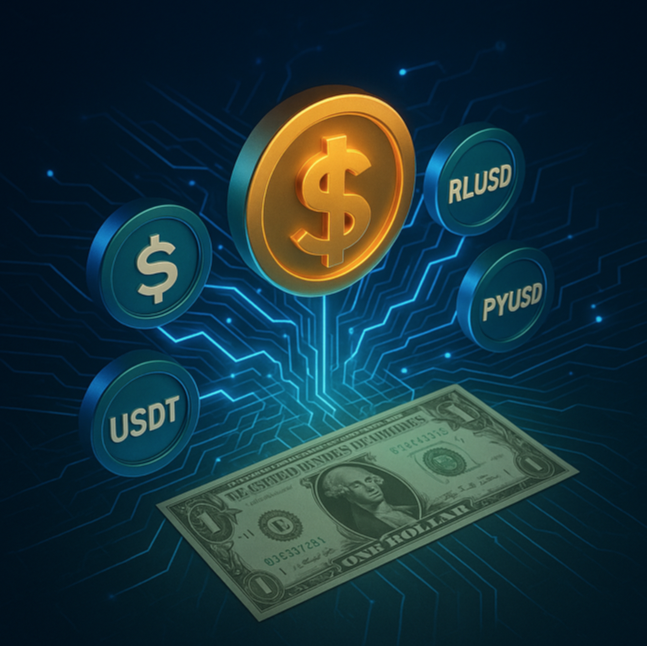
In the United States, the most commonly used centralized stablecoins are USDC (Circle), USDT (Tether), and PYUSD(PayPal). These coins are backed by real-world assets like dollars, short-term Treasury bills, or cash equivalents. Because a company controls the reserves, these coins are considered centralized. There are also decentralized stablecoins, such as DAI and RAI, which rely on smart contracts rather than a company to hold collateral. In theory, decentralized stablecoins like DAI or RAI (or newer models such as RLUSD) protect users from corporate control and give them more privacy, though the technology is still evolving.
Stablecoins will be the version of money in your checking and saving accounts going forward. You will be able to make profits by staking it. It will be used for lending, borrowing, cross-border payments, payroll systems, and everyday spending inside the new financial system. Stablecoins offer fast settlement, low fees, and global access. As governments move more aggressively toward digital payments, stablecoins may become the bridge between traditional finance and blockchain-based banking.
The idea of stablecoins becoming programmable money depends on the type. Centralized stablecoins already have semi-programmable features, such as the ability to freeze assets if required by law. If governments issue true central bank digital currencies (CBDCs), that kind of money could become fully programmable—meaning spending limits, time limits, or purchase categories could technically be enforced at the code level. Decentralized stablecoins, on the other hand, resist this because no single authority can control them.
Stablecoins sit right between the old world and the new one. They carry the familiarity of dollars but work with the speed and flexibility of crypto. Whether they become tools of convenience or tools of control will depend on who issues them and how much power users are willing to give up.
New investors like you are encouraged to look at the white papers for coins they are interested in. I found that to be tedious, and because I am not a tech, I only understood 10% of what I was reading. Going forward, I would suggest utilizing an AI tool such as ChatGPT to help you better understand the white paper. I also suggest that you download Crypto Bubbles and track price movements of coins you are interested in. We will learn about the various types of trading strategies and trading platforms in the next lesson. Tootles!
Supplemental References
These links are educational and safe for new learners:
Crypto Basics
https://www.investopedia.com/terms/c/cryptocurrency.asp
Bitcoin History
https://www.coindesk.com/learn/brief-history-of-bitcoin/
Ethereum Whitepaper (Plain English Overview)
https://ethereum.org/en/whitepaper/
What NFTs Actually Are
https://www.theverge.com/22325054/nft-explainer-what-is-blockchain-crypto-art
Stablecoin Information
https://www.circle.com/en/usdc
https://makerdao.com/en/whitepaper/ (DAI)
Privacy Coins
https://z.cash/technology/
https://www.getmonero.org/resources/about/
ISO 20022 (Official Site)
https://www.iso20022.org/
›