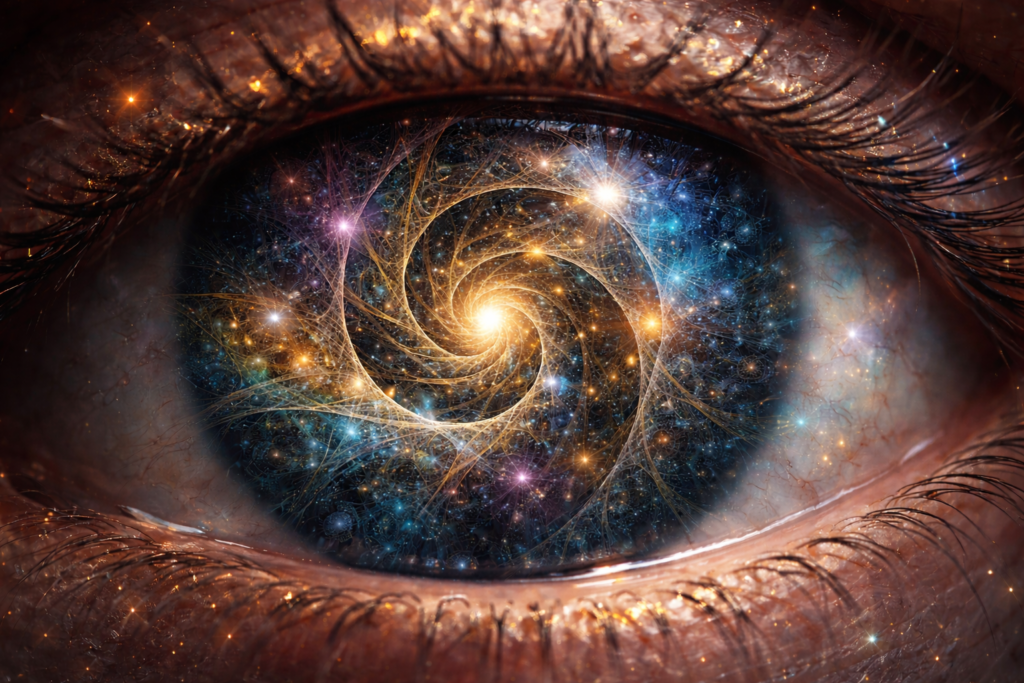
The universe is not static, solid, or objective. It is dynamic, patterned, and participatory. From galaxies to atoms, from biology to consciousness, reality appears to organize itself through repeating structures, energetic relationships, and information. If reality itself is responsive, then abundance is not merely economic—it is perceptual. This article examines how mindset shapes experience, and how abundance begins internally before it ever appears externally.
By now, you have likely heard that we live in a holographic, fractal universe. This idea is often discussed as if it were merely a theory—something to casually ponder over a latte. At its core, the concept suggests that what we experience as reality is a three-dimensional projection of underlying informational patterns, where structures repeat infinitely and each part reflects the blueprint of the whole. Fractals appear not only in the distribution of galaxies, but also in biological systems and natural forms on Earth.
This perspective appears across ancient philosophies, modern physics, and contemporary consciousness studies. There was only ever one source of matter and energy. Nothing that exists exists outside of all that is. The infinite intelligence of which we are all a part—collectively—has been called the Whole, Source Energy, or God, depending on cultural and philosophical framing. The most important external force sustaining life on Earth is the Sun, later symbolically reframed in religious language as the Son, the Son of Man, and even embodied in figures such as Jesus.
So what evidence supports this worldview?
The most striking observation is that the physical world—our bodies included—is composed primarily of empty space, experienced as solid due to the energetic and magnetic forces that organize subatomic particles into stable patterns. What directed the unfolding of physical reality, from this perspective, is an underlying intelligence that governs order, structure, and emergence.
There is strong scientific consensus that the universe expanded from an extremely dense, hot initial state approximately 13.8 billion years ago. Evidence for this includes Hubble’s Law, the cosmic microwave background, the abundance of light elements, and the large-scale structure of the cosmic web. Hydrogen, the first element to form, consists of a single proton, neutron, and electron—subatomic components that occupy only a tiny fraction of the apparent space of the atom itself. All heavier elements are constructed from this same foundation.
Matter’s “stickiness”—its ability to bond and form structure—arises from energetic attraction and electromagnetic forces. Life, the animating principle of matter, appears to develop along recurring mathematical and geometric patterns: sacred geometry, Platonic solids, the golden ratio, and Fibonacci sequences. Living organisms generate toroidal electromagnetic fields, which interact with broader energetic environments. In physics, this is sometimes discussed in relation to fundamental fields that permeate space, including the Higgs field and the Quantum field.
Everything is influenced by light and vibration. Everything is in motion. Everything is connected. Nothing exists in isolation. From this viewpoint, reality is not strictly objective; it is filtered through perception. What we experience is shaped by individual and collective interpretation.
So what does this have to do with abundance—and an abundance mindset?
Quantum mechanics has demonstrated that observation plays a role in measurement outcomes. The observer effect, quantum entanglement, and the probabilistic nature of reality suggest that participation matters. While these effects are subtle and often misunderstood, they raise important questions about attention, intention, and perception. Our beliefs, emotions, and expectations filter how we interpret events and how we respond to them.
No two people experience the same event in precisely the same way. An individual who perceives the world through scarcity carries a different internal state than one who perceives opportunity and abundance. These internal states influence behavior, decision-making, risk tolerance, creativity, and resilience. Over time, they shape outcomes. They also influence the response of the quantum field, which mirrors the energetic signature of the observer.
We are always manifesting, whether consciously or unconsciously. We tend to notice what we expect to notice. We gravitate towards others that share the same state we are experiencing ourselves. We often receive what we expect to receive or what we feel in our heart we deserve. As the saying goes, we are what we attract—and the evidence is the reality we experience. Mindset and subconscious beliefs are powerful creators of the world we experience.

Several authors have explored manifestation as the deliberate cultivation of belief, emotion, and attention with the aim of shaping lived experience. Among those whose work has influenced this perspective are Neville Goddard, author of Feeling Is the Secret; Abraham Hicks, authors of Ask and It Is Given; Joe Dispenza, author of You Are the Placeboand Becoming Supernatural; and Louise Hay, author of You Can Heal Your Life. Prolific writer, Gregg Braden, author of The Divine Matrix, is another powerful teacher on the subject of the subconscious mind.
“The world around us is nothing more and nothing less than a mirror of what we have become from within.” — Gregg Braden
“A belief is only a thought I keep thinking.” — Abraham Hicks
“The quantum field responds to who we are being.” — Joe Dispenza

With this in mind, we have the opportunity to influence our lives by consciously choosing what we focus on, which thoughts we reinforce, and how we feel in the present moment. These internal choices shape future outcomes. I refer to this intentional reconditioning as an abundance (self) brainwash and hygiene for the etheric body.
Abundance Manifesto (Sidebar)
The Abundance Manifesto
- Abundance is not external—it is a state of alignment.
- Attention is currency. What I focus on expands.
- Beliefs are programs. Repetition installs them.
- Emotion is signal. The body broadcasts before the mind explains.
- Expectation shapes perception; perception shapes outcome.
- I receive in proportion to what I allow myself to feel now.
- Scarcity is learned. Abundance is remembered.
- I am not reacting to reality—I am participating in it.
- What I assume to be true becomes operational.
- I choose abundance as a baseline, not a reward.
Reference Perspectives & Suggested Reading
Physics & Cosmology
- David Bohm — Wholeness and the Implicate Order
- Leonard Susskind — The Black Hole War (holographic principle)
- Brian Greene — The Elegant Universe
- Stephen Hawking — A Brief History of Time
Systems Theory & Fractals
- Benoît Mandelbrot — The Fractal Geometry of Nature
- Fritjof Capra — The Tao of Physics; The Web of Life
- Gregg Braden — The Divine Matrix
Neuroscience & Psychology
- Joe Dispenza — You Are the Placebo; Becoming Supernatural
- Lisa Feldman Barrett — How Emotions Are Made
- Carol Dweck — Mindset
Consciousness & Philosophy
- David Chalmers — The Conscious Mind
- Bernardo Kastrup — Why Materialism Is Baloney
- Rupert Sheldrake — The Science Delusion
Manifestation & New Thought
- Neville Goddard — Feeling Is the Secret
- Esther & Jerry Hicks — Ask and It Is Given
- Louise Hay — You Can Heal Your Life
- Wallace D. Wattles — The Science of Getting Rich
Leave a Reply